Preface
Before we start, I should point out: I am not a doctor. I have no medical training. I only have a couple years’ worth of herbal studies, so I consider myself a student of herbalism more than a practitioner. Nothing in this post should be read as medical advice or even as herbal advice; I am, in fact, barred from providing herbal advice by virtue of being a Maine Master Gardener Volunteer.
But I am allowed to tell you about my final project for the Racemes of Delight program, which I’ve worked on since classes ended in early November. I hope you find value in what I’m sharing, but it’s a project report, not advice.
I will give this one piece of advice, though: if you’re going to try a new-to-you herb, especially if you have any medical conditions or are on any medications, it’s best to talk to your doctor and/or pharmacist first and also to start with only a small amount, to make sure it agrees with you.
If you want to skip ahead, you can go straight to the recipe, as long as you promise to at least read the bold parts of the precautions as well.
Project goals
The Racemes of Delight program ends in a medicine show. Each student brings one or more teas, tinctures, salves, shrubs, oxymels, etc. that they’ve formulated over the last few months of class to show off, ideally allowing others to smell and taste their creations. Because I only attended distance sessions, it didn’t occur to anyone that I could present a project over Zoom until a couple of days before it happened. Rather than rush, I opted to take more time creating something and to share it via a blog post. (And Zoom was misbehaving all that day, so I’m glad this is how hit ended up.)
For my project, I set out to create a tea blend that might help a person through hard times … just, you know, as a fun hypothetical exercise.
Imagine, if you will, living during a difficult period of history, a time in which one’s heart is heavy with the weight of everything they’re witnessing, in which one feels tired and depleted but also overwhelmed, anxious, and stressed. Imagine someone having to constantly fight feelings of helplessness, because it all seems like so much. There’s danger ahead, and also uncertainty. … That would be hard on a person’s body and mind.
So my goal was blend some herbs into a tea that might relieve a little bit of a person’s heartache and stress, help them ground themself, and give them some strength to help them carry on, working to save what and who they can. The tea would also have to taste nice, both because someone living through this would deserve some pleasant experiences and because “drink your tea” shouldn’t become another item on a to-do list during hard times; it should be a source of joy.
I wanted it to be helpful to as many people as it could be, so I tried to use herbs that are safe for as many people as possible and for which the safe dosages are high (“food-like,” to use the terminology). I also wanted to stick to herbs that are easy to acquire. And here is a little bit of herbal jargon that you’re free to skip, but I was aiming to get as close to energetically neutral as I could: nothing that anyone would find too cooling, heating, drying, or moistening.
In a departure from my usual approach to herbs, I focused more on the emotional side of these plants than on their effects on the physical body, though I (of course!) considered both, as you’ll see if you read the next section.
Research montage
I knew from the first glimmer of the idea for this tea that I would be building it around hawthorn; it’s one of my favorite herbs, a relaxing nervine with a strong affinity for the heart (both emotionally and physically), offering nutrition and fighting inflammation. Rosalee de la Forêt says (same link) hawthorn “is for when you’re feeling broken hearted, experiencing a loss of heart or when you find yourself in a self-protective and walled-off survival mode during a stressful season.” And I can’t find the quote — I think it was said aloud during one of Rosalee de la Forêt’s classes — but it was something like, “if you love someone, give them a mug of hawthorn tea each morning, but only if you love them a lot,” with the implication that it’ll make them live longer.
It is also a protective herb, and I would wish protection upon anyone who felt a need for this tea.
Hawthorn’s leaves and flowers were an obvious choice for a tea. I’d have loved to have used the berries (“haws”), too, but they need longer in the water (really, some time at a boil) to release their constituents and their flavor.
Energetically, hawthorn is slightly cooling and considered “dry to neutral.” Maybe it’s just me misinterpreting its astringency as dryness (herbal energetics aren’t my best thing), but I felt like I needed a moistening plant to balance it, something else with a heart affinity. My first choice was violet, another nourishing plant, but I liked that it has a more active vibe, offering a sense of joy and of movement. One source mentioned using it for “anger headaches and ‘discontented mind,'” which felt pretty perfect. And I like its taste. The thing is, violet can’t be found at any online herb retailer right now; even my own supply is running low. Perhaps in the spring, it could be re-added to this formulation, but for winter I’ve had to leave it out. Its replacement was the last herb I added, though, so I’m going to skip to the next herb I settled on:
Lavender insisted on being included, or perhaps it was my brain that insisted lavender should go in. I’ve found myself craving it, and I couldn’t bring myself to leave it out of the tea entirely — though its contribution to the flavor is pretty subtle. Lavender is another relaxing nervine with anti-inflammatory properties, but its inclusion is largely about getting necessary rest and grounding oneself. To be formal, I’d point out that it has been well studied for fighting anxiety, depression, headaches, and pain. And, sure, I’d acknowledge that some (most?) of those studies are about the scent of the essential oil, rather than the constituents of the herb itself. But informally, on a personal level? It helps me with all four of those things. To be even less formal? I just feel like it’s a great herb for turning down the volume and getting out of frenzy mode, which is something someone living through challenging times might need.
I wanted ashwagandha in this tea. I really did. It’s calming while increasing energy, which felt so necessary. It gives a cognition boost, which seemed useful. It’s safe even in pretty large quantities and doesn’t taste bad. … But it’s a root. People most often take it as a powder. If you’re going to try infusing and drinking a root, you aren’t going to do it in a cup with a bunch of leaves, as a rule. Roots usually need longer to steep, and I just can’t find much in the way of reliable sources talking about ashwagandha as a tea. I’ll leave this page of information about ashwagandha here, because I’m looking for ways to add it to my life; maybe it’ll appeal to other people, too.
I considered rose, as well. I liked its flavor (in very small quantities) in an early version of the tea, and I don’t regret buying some to have on hand for myself — I’ve been sitting on a rose cookie recipe for two years! — but being realistic, I thought its inclusion would drive the price too high, for properties we could get from other, less expensive herbs. Plus, even more so than lavender, people might be tempted to pull rose petals from florists’ bouquets, and there are some nasty pesticides there. So it was rejected, though of course anyone who already had some around could certainly add a tiny sprinkle if it would bring them joy.
Oatstraw showed up in an early version of this tea blend, too, but I later learned (relearned?) that that’s really better as an overnight infusion or boiled for a long time, which was, after all, what I had originally bought it for. (I like to throw that and some hawthorn berries into a pot and cook them for a while to make a nice nutritious decoction.) So no oatstraw in this blend, because it’s better used in other ways.
There was another relaxing nervine that I felt I needed to consider: holy basil, also known as tulsi. It is beloved among my herbal community, but it has just never settled all that well for me when I’ve tried consuming it. I don’t know if it’s too dry — I don’t think it’s too hot, because ginger is my best pal and also extremely hot — or if there’s something else about it, but it’s an herb I’ve bounced off of several times. I still felt that it deserved a fair shot, so I purchased the mildest form, Rama tulsi (Ocimum sanctum), which is conveniently also the easiest to buy, and decided it would be one of the smaller parts of the blend, if it went in.
Why the fair shot? Well, I had to give up on aswhagandha but still wanted something to help with thinking straight during stressful times. Tulsi is a powerful adaptogen (there’s a great definition on that page for anyone who wants it), anti-inflammatory, stress-relieving, and just super full of really nice properties. I’ve heard multiple people in my class say that they find it soothing and joyful; one person compared its energy to that of rose, even saying it tasted “pink” to them.
And it tasted nice with the other herbs in the early versions of this tea that used violet, so it stayed. (It does not taste like the basil most of us have in our kitchen.)
The last herb to join the blend was one that I didn’t have as much familiarity with. I started looking at it because it has a lot in common with violet: an association with joy, affinity with the heart, cooling and moistening energetics, sweet taste, usefulness in a nourishing infusion (which means it offers vitamins and minerals), immune modulation, and anti-inflammatory properties. I wasn’t sure I would like its flavor as much as violet’s, and I was a little sad to lose the “get things moving” aspect of violet’s actions, but I ordered some and gave it a try. I’m glad I did! A couple of weeks ago linden took its place as the last ingredient in — but also the second largest constituent of — this tea.
The thing I like about linden, in this tea? Besides all those things in the last paragraph? If one’s muscles are tight from stress, like maybe one needs reminders to “get your shoulders out of your ears” or “unclench your jaw,” linden’s an herb worth considering. That felt right. Linden has a lot going for it.
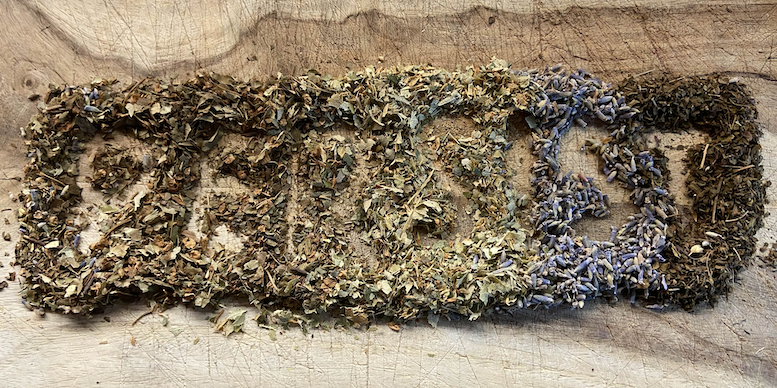
So that’s the tea: hawthorn leaves and flowers, linden leaves and flowers, Rama tulsi leaves, and lavender flowers.
I take it as a good sign that pairs of these herbs are often used together:
- Lavender and linden “contain immunomodulating polysaccharides that could be useful for support of compromised immune system.” That wasn’t something I was specifically looking for, in trying to craft this tea, but given that we are still circulating an immune-system-damaging virus, I also figure it can’t hurt.
- “Linden is regularly paired with hawthorn (Crataegus spp.) leaves, flowers, and berries. This is a combination that is nourishing and supportive to general heart health, but also specifically indicated for hypertension and inflammation of the cardiovascular system.”
- All but one of these herbs (lavender) show up in Rosalee de la Forêt’s recommendations for wildfire smoke.
The recipe, two ways
By volume (which is how I blended it):
- 2 parts dried hawthorn leaves and flowers
- 2 parts dried linden leaves and flowers
- 1 part dried lavender flowers
- 1 part dried Rama tulsi leaves
By weight (approximate, based on measured weights while I blended by volume):
- 3 parts dried hawthorn leaves and flowers
- 2 parts dried linden leaves and flowers
- 1 part dried lavender flowers
- 1 part dried Rama tulsi leaves
When I’m mixing up tea to taste, each “part” in the recipe by volume is a tablespoon, and it goes in a little jar. After I try a few cups and know I like it, I’ll make a larger batch: depending on the size of my storage container, I use whatever makes sense, maybe a quarter-cup or third-cup measuring cup if it’s going in a pint jar. The main thing is to keep one’s dried herbs in something airtight.
To make a mug of tea, put a heaping teaspoon into an infuser (either one of these mesh dealies or, for folks who can’t abide any plant matter in their tea, a paper tea filter) and steep for 5 minutes, covered — that’s how you get the most out of the tulsi. (Or one could steep longer, uncovered, which is what I do most of the time.)
I use at least a tablespoon of tea for a 20 ounce mug.
Perhaps because the linden and hawthorn are both a bit astringent, my second taste tester (my spouse) thought I’d given him a black tea with herbs added, rather than a pure tisane (herbal tea, no actual tea leaves). We agree that, like a black tea, this could be enjoyed with milk and sweetener, if one so desires. I usually put in just a tiny bit of honey.
Once I’ve made someone else’s recipe, I always feel welcome to add things that I enjoy. For instance, assuming I didn’t have any trouble with stomach acid (no GERD or acid reflux) and liked the flavor, I’d consider throwing a pinch of whichever mint (peppermint, spearmint, lemon mint, etc.) most appeals to me into a cup, to see how I like it. Or food grade rose petals, if I had them on hand already. Or if it’s nearly bedtime, maybe some chamomile (I mean, I wouldn’t, because I’m allergic to it, but if I weren’t, it’d be a nice addition), or lemon balm (assuming my thyroid is generally well-behaved).
Precautions
All of the precautions (particularly the quoted portions) come from Rosalee de la Forêt’s information pages on these herbs and from the A-Z Guide to Drug-Herb-Vitamin Interactions Revised and Expanded 2nd Edition, edited by Alan Gaby.
Hawthorn is not to be used by people who have diastolic congestive heart failure. If I were in that boat, I would be inclined not to mess around with it at all, and I might reject this tea outright unless a medical professional told me otherwise.
Hawthorn requires caution for people who are on heart medications, especially digitalis and beta blockers. If I were in that boat, I would check with my doctor and an experienced herbalist, who might agree to allow this tea with the hawthorn cut down a bit, or as-is but in a very limited amount per day. (More on amounts below.)
A very small number of people experience contact dermatitis from linden, or find it hypes them up rather than calming them down. Since it was a new herb for me, I started by trying a very small amount, to make sure I tolerated it well.
DO NOT use lavender from a flower shop. Food-grade lavender and home-grown, pesticide-free lavender are the only safe lavenders to consume. (The species of lavender is less important than its intended use, but most herbalists use Lavandula angustifolia or another Lavandula species or cultivar.)
“Tulsi may have an anti-fertility effect … and thus should not be taken by couples wishing to conceive” or by people who are pregnant.
“Those who are taking insulin to control their diabetes may need to adjust their insulin levels while taking tulsi.” Having consistent amounts from day to day may help its effects become more predictable.
Sometimes people have allergies to herbs. So any new herb should be tried in small quantities, just in case. I’m allergic to like half the Asteraceae family and most of the Apiaceae/Umbellliferae, for instance.
Any herb can make you feel nauseated or cause other digestive distress in too large a dose. If that happens, decrease the amount. If it still happens, maybe you’ve found an herb that doesn’t agree with you. It happens, because bodies and plants are both weird.
This tea would be difficult, but technically not impossible, to drink too much of. When you gather Rosalee de la Forêt’s dosages of these four herbs, our very safe friend lavender appears to be the limiting factor; and even so, my math suggests a limit of 25 tablespoons of the dried herb mix per day (or ~200 ounces of prepared tea), once a person has determined that it agrees with them in smaller amounts.
- Hawthorn leaf and flower dosage: up to 30 grams per day
- Lavender flower dosage: 1 to 3 grams per day
- Linden flower and bracts dosage: 15-30 grams per day
- Tulsi leaves dosage: 2 grams to 113 grams (by weight)
Acquiring ingredients
I bought my herbs to test out my recipes from Mountain Rose Herbs (hawthorn, linden, Rama tulsi, lavender, ashwagandha); they also sell both styles of tea infuser. I’ve had luck in the past with Starwest Botanicals and occasionally with Frontier Co-op. Three of the herbs, plus infusers, are available at my old Pittsburgh go-to, Prestogeorge Coffee & Tea. (I have no relationship with any of these vendors/shops, though my membership in United Plant Savers gets me a discount at one or more of them.)
Clearly, I trust Rosalee de la Forêt. (I link her a lot here, because I can’t directly link to my notes from Wild Cherries or Racemes of Delight. Besides following her online, I’ve read one of her books and am taking one of her classes.) I also trust the Herbal Academy (with whom I’ve taken a class, too), and they have a longer list of suppliers, some with discount codes.
And, look: I have a fair amount of these herbs on hand, now. If we’ve exchanged addresses in the past, or phone calls, or hugs, I can just … send you some tea. Drop me an email or Discord message if you’d like to try it. (I can’t give you advice, but I can give you tea. I’d package it really formally if anyone international wanted it, because Customs is weird about these things.)
Final note
I reserve the right to improve upon this recipe over time. Like I said, I’m just a student. I imagine I’ll learn more about herbs and about blending teas, and my opinions will change. I’ll mark what I edit when I do, though, or if it’s a whole new recipe, I’ll make a whole new post and link it here.
Be First to Comment